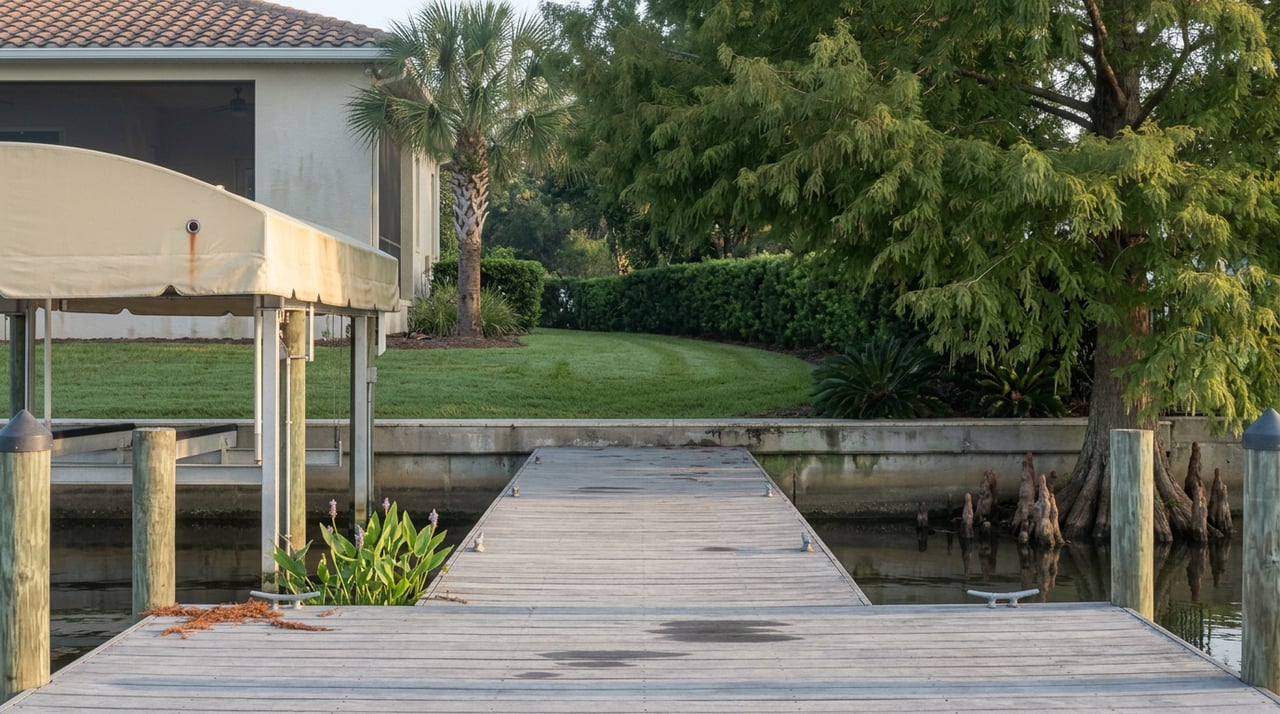
Ask most people what determines how fast a Butler Chain listing closes and they will point to the obvious variables: list price, buyer financing, inspection findings on the house itself. Those matter, but on this particular lake system they are rarely what stalls a deal. The variable that actually decides the calendar sits at the water's edge, in a filing cabinet somewhere, in the form of a permit that may or may not exist for the dock the listing photos made look so effortless.
The Butler Chain of Lakes carries a designation that most buyers, and more than a few sellers, don't know applies to their own backyard. That designation changes what a dock, lift, or seawall is allowed to be without state review, and it means the shoreline infrastructure on a Windermere lakefront property can take longer to clear than the rest of the transaction combined.
Why This Lake Gets a Different Rulebook
In 1985, the Butler Chain became the first water body in Florida to receive Outstanding Florida Waters status, a classification meant to preserve exceptional water quality and habitat. That protection is why the chain still looks the way it does after four decades of development pressure around it. It's also why the paperwork burden on shoreline structures here is heavier than on an ordinary Florida lake.
According to DG Firm's dock guidance, a single-family dock can skip the state permitting process entirely if it stays under a set size. On most Florida water bodies that ceiling is 1,000 square feet of over-water coverage. On Outstanding Florida Waters, including every lake in the Butler Chain, that ceiling drops to 500 square feet. Anything larger, and any seawall construction or repair, moves into a formal Environmental Resource Permit review through the St. Johns River Water Management District.
Two Permits, Two Clocks
This is the part that catches sellers off guard. A dock or seawall project on the Butler Chain doesn't answer to one authority. It answers to two, and they don't run on the same schedule.
| Layer | Governing body | What it covers | Typical timeline |
|---|---|---|---|
| State Environmental Resource Permit | St. Johns River Water Management District | New dock construction, dock expansion, seawall construction or repair, fill or excavation near the lake | 60 to 120 days for a standard application, longer for larger or more complex projects |
| County building permit | Orange County | The same physical structure, reviewed independently of the state permit | Runs on its own timeline, filed separately from SJRWMD |
| Statutory exemption | State of Florida, Chapter 403.813 | Small docks exempt from state permitting | 500 square feet ceiling on Outstanding Florida Waters, versus 1,000 square feet on most other Florida waters |
A buyer's financing can clear in thirty days. A standard SJRWMD review alone can run four months. When a dock needs work, or when its permit history is incomplete, the shoreline becomes the long pole in the tent, not the mortgage.
A four-month permit review doesn't move faster because a buyer is motivated. It moves at its own pace regardless of what else in the transaction is ready to close.
The Same Rule, Every Price Point
What makes this worth understanding before you list, rather than after an offer arrives, is that the permitting burden doesn't scale with the price of the house. It's the same rule whether the dock sits behind a $1.5 million cottage or a $9 million estate.
The Butler Chain's price bands illustrate the range this rule applies to equally:
- Historic in-town lakefront on streets like Eichelberger, Interlachen, and Lake Avenue, with direct Lake Butler frontage and older, character-driven homes, generally runs $1.5 million to $6 million.
- Gated Lake Butler frontage in communities like Butler Bay, built around newer custom construction, generally runs $2 million to $8 million.
- Isleworth, the chain's most recognized address with a private Arnold Palmer-designed course and round-the-clock security, has priced consistently between $4.9 million and $9.5 million.
- Trophy estates elsewhere on the chain push well past that, into eight figures for the largest lakefront lots with extensive dock and guest house infrastructure.
None of that price variation buys a shortcut through SJRWMD review. A $1.6 million cottage on Interlachen and a $7 million estate in a gated community file the same form, wait on the same 60 to 120 day clock, and face the same 500 square foot exemption ceiling. The lake doesn't grade on price.
What Doesn't Show Up in the Photos
The other piece sellers underestimate is what happens to an unpermitted or undocumented structure at closing. The Duncan Seawall guide says unpermitted dock work can trigger fines, stop-work orders, or a required removal.
A buyer's inspection period is where an incomplete permit history gets discovered, and discovery during due diligence is a far worse position for a seller than discovery before the listing goes live.
Seawall condition adds its own cost variable. For Windermere lakefront specifically, replacement runs an estimated $500 to $1,500 per linear foot, a range wide enough that a seawall in visibly good condition can still carry a very different repair number depending on its age and construction method. A pre-listing engineering assessment, not just a visual walk-through, is the only way to know which end of that range applies to a specific property.
Local inspection firms have adapted to this reality. Closer Look Inspections, which handles lakefront work across the Butler Chain including Keene's Pointe and Isleworth, treats dock structures, boathouses, and seawalls as a distinct scope from the standard home inspection, closer to a marine assessment than a walk-through checklist. That distinction matters, because a general home inspector's report and a shoreline engineering assessment are not interchangeable documents when a buyer's lender or insurer starts asking questions.
Before You List: The Shoreline File
For a seller planning to bring a Butler Chain property to market, the file that matters most isn't the appraisal. It's the shoreline paper trail, and it's worth assembling before a single showing happens.
- Pull the current SJRWMD permit record for the dock and any seawall work, searchable directly through the district's records.
- Request the Orange County building permit history for the same structures, since it's a separate filing from the state record.
- Confirm deeded riparian rights and that any dock or slip is legally tied to the parcel being sold.
- Order an engineering or marine contractor assessment of the seawall, distinct from the general home inspection.
A file like this doesn't just speed up a transaction. It changes the conversation with a buyer's agent from "let's find out what's wrong" to "here's what you're buying and here's the proof." On a lake where the state and county each keep their own separate record of the same structure, that proof is the difference between a clean sixty-day close and a shoreline permit that quietly becomes the whole negotiation.
A Few Direct Questions
Does every dock on the Butler Chain need a state permit? Not if it stays under 500 square feet of over-water coverage, the exemption ceiling for docks on Outstanding Florida Waters under Florida Statute 403.813. Anything larger, along with any seawall construction or repair, requires a full Environmental Resource Permit through SJRWMD.
Does a dock need documentation? Buyers, lenders, and insurers all tend to ask for that record directly.
How long should a seller budget for permit verification before listing? Pulling existing records from SJRWMD and Orange County can typically be done in a matter of weeks. If a permit is missing or a structure needs new approval, budget for the full 60 to 120 day standard review window, longer if the project is unusually large or complex.
The Butler Chain rewards patience with the paperwork the same way it rewards patience with pricing. A dock or seawall file assembled before a property goes to market is one less variable working against the timeline once an offer is on the table.
Danholm Collection works with Windermere lakefront sellers to get that file in order before the first showing, not after the first question from a buyer's agent. If you're weighing a listing on the Butler Chain, book your strategy consultation and we'll walk through exactly what your shoreline record needs to say.
This article is general information, not legal, tax or financial advice. Consult a qualified professional about your situation.
